
0
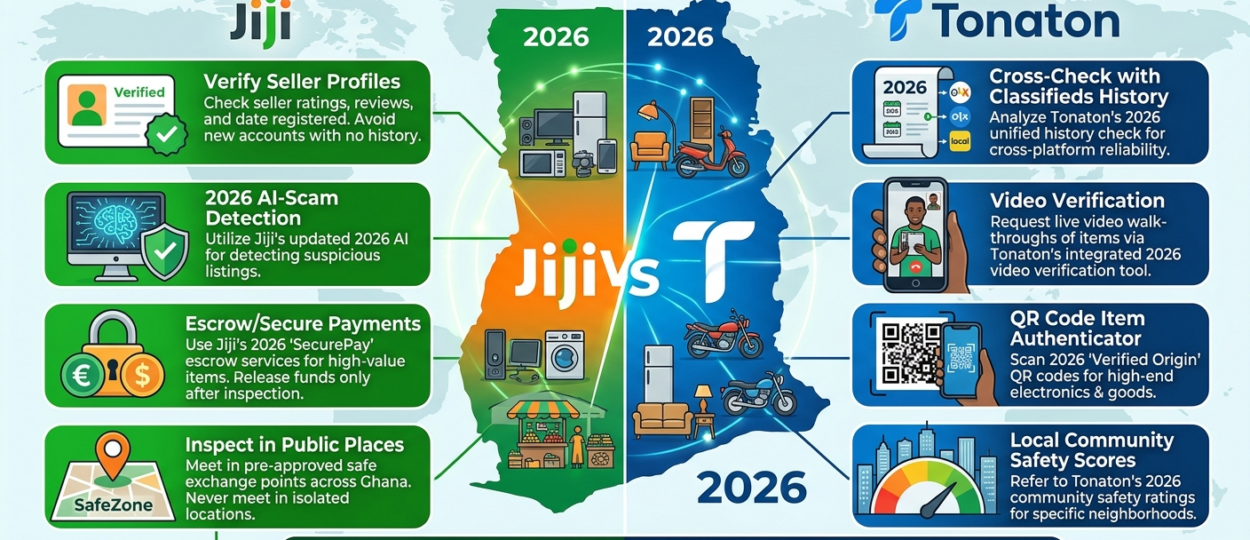
Jiji Ghana vs Tonaton: How to Buy Used Items Safely in 2026
What Happened to Tonaton?
In 2022, Tonaton, Ghana’s largest classifieds platform, was fully absorbed into Jiji Ghana. The familiar blue and white brand disappeared, and all listings migrated to Jiji’s platform. If you’re searching for Tonaton today, you’re automatically redirected to Jiji—it’s now the only major peer-to-peer marketplace for used items in the country.
But with that consolidation came challenges. Jiji now hosts millions of listings across Ghana, and not all sellers are honest. This guide shows you exactly how to buy used cars, furniture, phones, and electronics safely.
Step-by-Step: How to Buy Safely on Jiji Ghana
1. Search With Filters
Jiji’s default feed is a firehose. Immediately apply filters: location (Accra, Kumasi, etc.), price range, and condition (New vs Used). This weeds out irrelevant listings and sellers operating from regions you can’t physically visit.
2. Check the Seller’s Profile
Click the seller’s name. Look for:
- Registration date: Accounts created in the last 30 days with multiple high-value listings are suspicious.
- Verification badge: A green checkmark means Jiji has verified their identity. No badge doesn’t automatically mean scam, but proceed with extra caution.
- Other listings: If a seller has 50 iPhones all at “too good to be true” prices, it’s a scam operation.
3. Chat on Jiji, Not WhatsApp Immediately
Scammers try to move conversations to WhatsApp quickly so Jiji can’t monitor messages. Keep initial discussions on the Jiji chat platform. If a seller refuses and insists on WhatsApp only, that’s a red flag.
4. Request a Video Call
Ask the seller to show the actual item on a live video call—not a pre-recorded clip. Scammers steal photos from other listings or overseas websites. A legitimate seller will happily show the product in real-time.
5. Meet in Public, Bring a Friend
For high-value items like cars, phones, or laptops, arrange to meet at:
- Police stations (many in Accra allow safe transaction meet-ups)
- Shopping mall parking lots (Accra Mall, Junction Mall, West Hills Mall)
- Banking halls (there’s CCTV everywhere)
Never go alone for items above GH₵2,000.
6. Inspect Before You Pay
For phones: dial *#06# to get the IMEI, then check it on GSMA’s device registry. For cars: take a mechanic. For electronics: test them on-site. Once you send MoMo, the money is gone permanently.
7 Red Flags Specific to Jiji Ghana
- Seller demands MoMo before meeting: Block immediately.
- “I’m out of town, but my brother/delivery guy will bring it”: Classic scam script.
- Photos show a different background in every image: Stolen from multiple sources.
- Price is 60%+ below market value: No one sells a genuine iPhone 14 for GH₵3,000.
- Refuses video call: Has something to hide.
- Pressure to buy now: “Five other people are interested.” Walk away.
- Only accepts payment before viewing: Absolutely never do this.
Jiji vs Facebook Marketplace: Which Is Safer?
Jiji offers some accountability—verified badges, a reporting system, and chat monitoring. Facebook Marketplace has none of these. However, Facebook allows you to see a seller’s full social profile, mutual friends, and activity history, which can serve as a trust check. Both require the same in-person safety protocols.
Verdict: Use Jiji as your primary search tool, but apply this safety checklist regardless of platform.
For a complete comparison of every major shopping platform in Ghana, including Jumia, Melcom, and Ubuy, see our full online shopping in Ghana guide.
What Happened to Tonaton?
In 2022, Tonaton, Ghana’s largest classifieds platform, was fully absorbed into Jiji Ghana. The familiar blue and white brand disappeared, and all listings migrated to Jiji’s platform. If you’re searching for Tonaton today, you’re automatically redirected to Jiji—it’s now the only major peer-to-peer marketplace for used items in the country.
But with that consolidation came challenges. Jiji now hosts millions of listings across Ghana, and not all sellers are honest. This guide shows you exactly how to buy used cars, furniture, phones, and electronics safely.
Step-by-Step: How to Buy Safely on Jiji Ghana
1. Search With Filters
Jiji’s default feed is a firehose. Immediately apply filters: location (Accra, Kumasi, etc.), price range, and condition (New vs Used). This weeds out irrelevant listings and sellers operating from regions you can’t physically visit.
2. Check the Seller’s Profile
Click the seller’s name. Look for:
- Registration date: Accounts created in the last 30 days with multiple high-value listings are suspicious.
- Verification badge: A green checkmark means Jiji has verified their identity. No badge doesn’t automatically mean scam, but proceed with extra caution.
- Other listings: If a seller has 50 iPhones all at “too good to be true” prices, it’s a scam operation.
3. Chat on Jiji, Not WhatsApp Immediately
Scammers try to move conversations to WhatsApp quickly so Jiji can’t monitor messages. Keep initial discussions on the Jiji chat platform. If a seller refuses and insists on WhatsApp only, that’s a red flag.
4. Request a Video Call
Ask the seller to show the actual item on a live video call—not a pre-recorded clip. Scammers steal photos from other listings or overseas websites. A legitimate seller will happily show the product in real-time.
5. Meet in Public, Bring a Friend
For high-value items like cars, phones, or laptops, arrange to meet at:
- Police stations (many in Accra allow safe transaction meet-ups)
- Shopping mall parking lots (Accra Mall, Junction Mall, West Hills Mall)
- Banking halls (there’s CCTV everywhere)
Never go alone for items above GH₵2,000.
6. Inspect Before You Pay
For phones: dial *#06# to get the IMEI, then check it on GSMA’s device registry. For cars: take a mechanic. For electronics: test them on-site. Once you send MoMo, the money is gone permanently.
7 Red Flags Specific to Jiji Ghana
- Seller demands MoMo before meeting: Block immediately.
- “I’m out of town, but my brother/delivery guy will bring it”: Classic scam script.
- Photos show a different background in every image: Stolen from multiple sources.
- Price is 60%+ below market value: No one sells a genuine iPhone 14 for GH₵3,000.
- Refuses video call: Has something to hide.
- Pressure to buy now: “Five other people are interested.” Walk away.
- Only accepts payment before viewing: Absolutely never do this.
Jiji vs Facebook Marketplace: Which Is Safer?
Jiji offers some accountability—verified badges, a reporting system, and chat monitoring. Facebook Marketplace has none of these. However, Facebook allows you to see a seller’s full social profile, mutual friends, and activity history, which can serve as a trust check. Both require the same in-person safety protocols.
Verdict: Use Jiji as your primary search tool, but apply this safety checklist regardless of platform.
For a complete comparison of every major shopping platform in Ghana, including Jumia, Melcom, and Ubuy, see our full online shopping in Ghana guide.